Runtime Governance Infrastructure for Agentic Execution
CHURPRIMO™ is the runtime governance layer that enforces execution stability. Coherence is continuously evaluated as a runtime condition. Instability constrains continuation. Recovery is enforced before execution resumes. Underlying models remain unchanged.
What is CHURPRIMO™
CHURPRIMO™ establishes the runtime control boundary between orchestration and execution.
Runtime governance is a structural layer that operates during execution — not before it, and not after it. It enforces coherence as a continuation condition, constrains unstable execution, and requires recovery before continuation is permitted.
This is not guardrails. It is not monitoring. It is enforcement infrastructure.
Instability invalidates continuation.
Recovery is enforced before execution resumes.
Execution proceeds only under governed stability conditions.
Governance is enforced at runtime, independent of model architecture.
Execution state transitions are constrained, governed, and auditable.
Figure 1. Coherence as a measurable runtime signal.
The Real Failure Mode of Autonomous Systems
Systems do not become unstable at the point of failure. They become unstable at the point where drift is no longer recognized.
The primary risk is not that systems fail — it is that they continue operating while misaligned. Outputs are treated as independent predictions rather than as components of a dynamic system under load.
Most systems remain outwardly functional while coherence degrades underneath. The result is silent misalignment, runaway feedback, and delayed discovery of failure.
Observability can surface degradation. It cannot impose constraint. CHURPRIMO is the governance layer that makes coherence enforceable during execution — not merely observable.
CHURPRIMO constitutes the runtime governance layer that constrains unstable continuation, enforces recovery, and restores controlled execution before continuation is permitted.
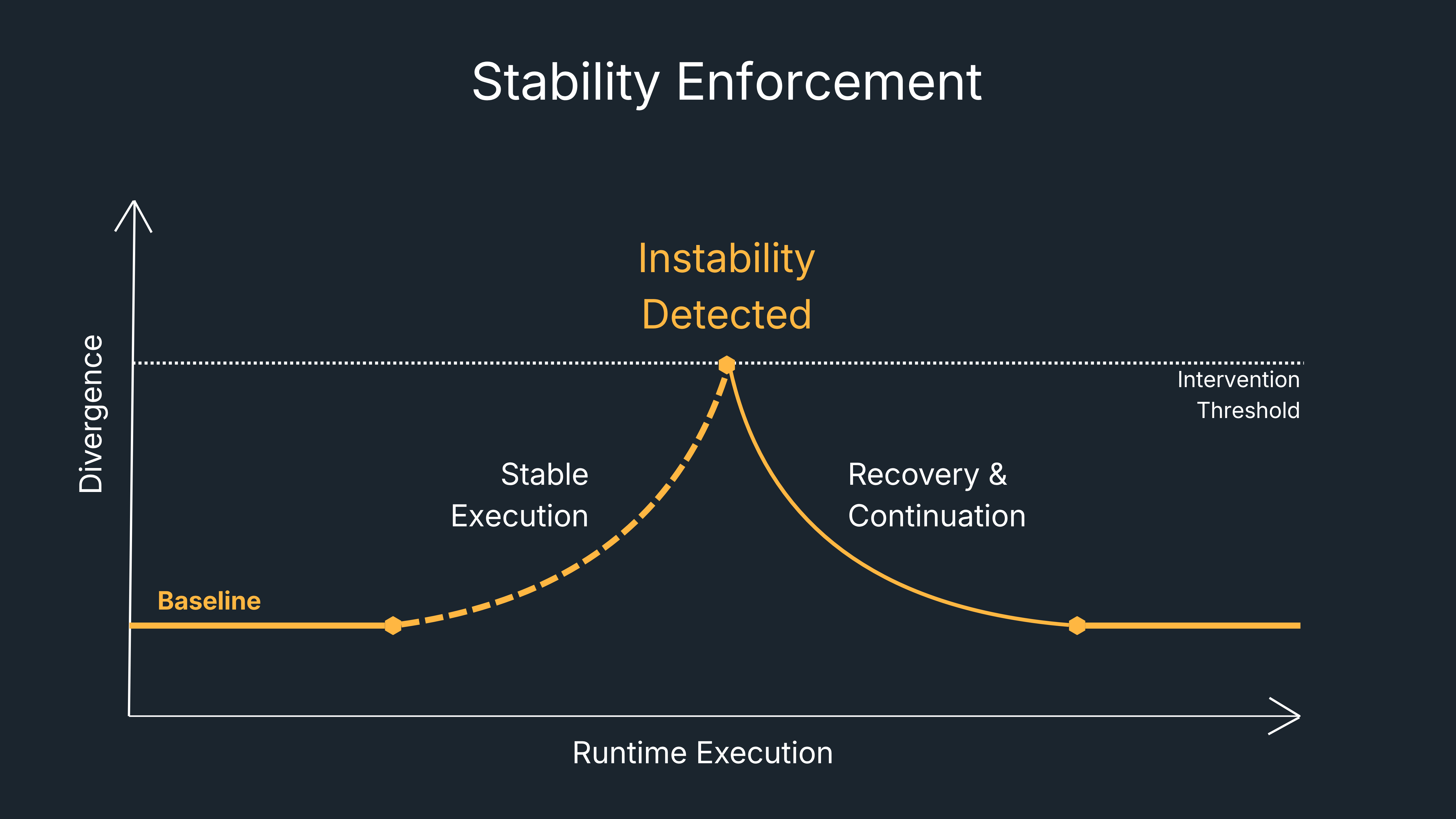
Figure 2. The correction mechanism: ungoverned execution amplifies into runaway incoherence; governance enforces recovery at threshold breach.
What Is System Coherence?
Coherence is the measurable capacity of a system to maintain or restore alignment across state, behaviour, and trajectory over time, despite internal drift or external destabilising conditions.
When these diverge, the system may still appear functional — but it is no longer reliably acting in accordance with its intent.
Coherence is a runtime control condition. When coherence degrades, rupture constrains continuation and recovery is enforced before execution resumes.
Figure 3. Coherence expressed as an evaluable alignment relationship.
The system's declared target: goals, constraints, and success criteria.
What the system is actually doing: actions taken, tool use, decisions, outputs.
The direction of execution over time: whether behavior is converging toward or away from the objective.
Core Concepts
CHURPRIMO establishes coherence as an enforceable runtime condition. These structural mechanisms govern execution stability, recovery, and continuation.
Coherence is evaluated relative to the phase the system is currently in.
Execution is constrained when coherence degrades. Recovery is enforced as a runtime condition, not an operator decision.
Execution cycles through seven empirically derived phases to constrain rupture and enforce recovery.
Coherence is continuously measured across three concurrent signal domains — not inferred after failure.
Where CHURPRIMO Matters Most
CHURPRIMO is required wherever execution persists across time and drift must be governed before it compounds.
In multi-agent systems, drift in one agent propagates through shared context. A single incoherent agent can destabilise the entire execution graph. CHURPRIMO governs coherence at the boundary between agents.
In tool-integrated environments, drift leads to incorrect tool use, sequencing errors, and compounding side effects. CHURPRIMO enforces trajectory coherence before tool calls are committed.
Sustained autonomy increases exposure to drift. The longer execution runs, the more opportunities for silent misalignment to compound. CHURPRIMO governs continuity across the full execution lifecycle.
Where humans and agents share execution context, undetected agent drift can corrupt collaborative state. CHURPRIMO maintains coherence at the human-agent boundary.
Example: Multi-Agent Orchestration Under Governance
Consider a multi-agent system coordinating research, tool execution, and synthesis under sustained autonomy. CHURPRIMO governs execution continuity: incoherence is bounded, rupture constrains continuation, and recovery is enforced before execution resumes.
A global objective is declared. Agents are instantiated with roles, constraints, and task scope. Coordination stabilises as work begins.
Agents expand subtasks, call tools, and generate outputs under governed execution. The system remains auditable and bounded.
Local optimisation begins to diverge from the global objective. Stability degrades and risk of propagation increases.
CHURPRIMO constrains continuation and enforces governed recovery until coherence is restored.
State is corrected and alignment is restored. Controlled execution resumes under governance with traceable recovery history.
Without governance, divergence can silently compound into runaway execution. With CHURPRIMO, instability is governed, recovery is enforced, and continuation is permitted only under restored stability.
Who This Benefits
CHURPRIMO is required wherever execution persists across time and instability must be constrained, governed, and recovered before continuation.
Teams evaluating alignment, drift detection, and structural safeguards in autonomous systems.
Framework builders coordinating tool use, delegation, and persistent agent workflows.
Organisations requiring enforceable control over long-running autonomous processes.
Builders deploying agents into environments where silent instability carries operational risk.
CHURPRIMO is unnecessary for static inference. It is governance infrastructure for systems that persist state, act over time, and therefore require enforceable coherence.
Why This Matters
As autonomy scales, systems that cannot govern their own execution coherence will remain fundamentally unreliable.
Coherence is not a property that can be assumed at deployment and trusted to persist. It must be enforced continuously, throughout execution, as a structural condition of autonomous operation.
CHURPRIMO introduces runtime governance as that structural layer — the control boundary that makes autonomous execution governable, recoverable, and auditable at scale.
This work reframes failure in autonomous systems as the result of unmanaged drift — and establishes enforcement infrastructure as the response.